
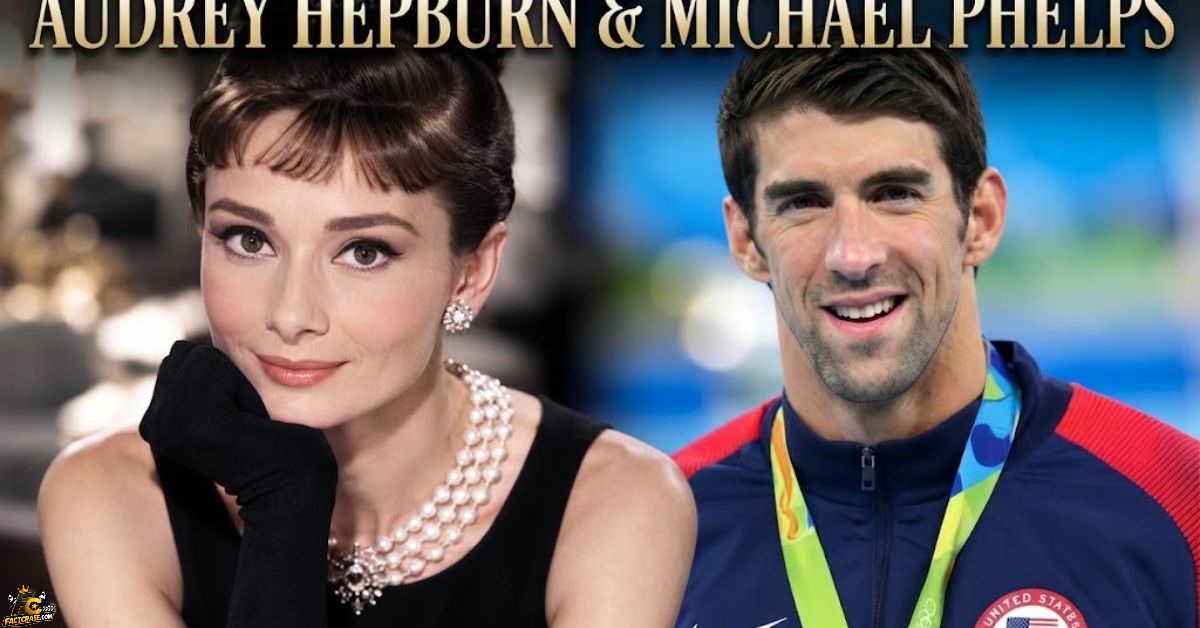

Audrey Hepburn and Michael Phelps represent two extraordinary paths to global fame, shaped by cinema and Olympic swimming. Audrey Hepburn, born Audrey Kathleen Ruston in 1929, became an acclaimed Belgian-British actress, fashion icon, and UNICEF humanitarian known for Roman Holiday, Breakfast at Tiffany’s, and My Fair Lady. Decades later, Michael Phelps emerged from Baltimore, Maryland, as a record-setting American swimmer and the most decorated Olympian in history, with 28 Olympic medals, including 23 gold.
Their careers were separated by generations, yet both transformed personal success into lasting cultural influence and public service. Hepburn championed children’s causes through UNICEF, while Phelps advocates for mental health and water safety after retiring from competition.
Who Were Audrey Hepburn and Michael Phelps?
Audrey Hepburn and Michael Phelps were born decades apart and achieved fame in completely different fields.
Audrey Hepburn, born Audrey Kathleen Ruston on May 4, 1929, became one of the defining actresses of Hollywood’s classic era. She was a Belgian-British actress whose career included celebrated films such as Roman Holiday, Sabrina, Funny Face, Breakfast at Tiffany’s, and My Fair Lady. Her elegant screen presence also established her as a major style icon.
Michael Fred Phelps II, born June 30, 1985, in Baltimore, Maryland, became a retired American swimmer and the most decorated Olympian in history. His record includes 28 Olympic medals, including 23 gold medals.
Their professional achievements were different, but both became global ambassadors whose influence reached beyond their original careers.
Audrey Hepburn and Michael Phelps — Quick Facts
| Fact | Audrey Hepburn | Michael Phelps |
| Full Name | Audrey Kathleen Ruston | Michael Fred Phelps II |
| Birth Date | May 4, 1929 | June 30, 1985 |
| Birthplace | Brussels, Belgium | Baltimore, Maryland, USA |
| Nationality | Belgian-British | American |
| Primary Profession | Actress and humanitarian | Professional swimmer |
| Major Breakthrough | Roman Holiday (1953) | 2004 Athens Olympics |
| Signature Achievement | Academy Award for Best Actress | 28 Olympic medals |
| Olympic Gold Medals | N/A | 23 |
| UNICEF Role | Goodwill Ambassador, 1988–1993 | Not affiliated as a UNICEF ambassador |
| Major Advocacy | Children’s welfare and humanitarian aid | Mental wellness and water safety |
| Family | 2 sons: Sean and Luca | 4 sons with Nicole Johnson |
| Death / Current Status | Died January 20, 1993, aged 63 | Living; retired from competitive swimming |
Audrey Hepburn: Early Life and Background
Audrey Hepburn was born in Brussels and spent part of her childhood in the Netherlands during World War II. Her mother was a Dutch baroness, while her father was an English-Austrian businessman. The wartime years had a lasting effect on her childhood, including periods when food was scarce and she became malnourished.
Before becoming a major actress, Hepburn trained as a ballet dancer. She later moved between Amsterdam and London, where she pursued performing opportunities. Her transition from dance to acting eventually changed the direction of her life.
How Did Audrey Hepburn Become Famous?
Hepburn’s breakthrough came through a combination of stage work, screen presence, and a distinctive personal style. Her appearance in Gigi helped attract attention before her Hollywood breakthrough in Roman Holiday.
Released in 1953, Roman Holiday paired Hepburn with Gregory Peck and gave her the role of Princess Ann. Her performance earned the Academy Award for Best Actress.
She subsequently appeared in major productions including:
- Sabrina
- Funny Face
- Breakfast at Tiffany’s
- My Fair Lady
- Always
Her portrayal of Holly Golightly in Breakfast at Tiffany’s became especially influential, while her performance as Eliza Doolittle in My Fair Lady became another defining role. Because Hepburn’s singing was partly provided by Marni Nixon, her performance history also reflects the studio-era practice of using professional singers for demanding musical roles.
Hepburn’s awards extended beyond film. She won a Tony Award, received a posthumous Emmy, and earned a Grammy, giving her the distinction commonly described as EGOT status.
Her influence also reached fashion. Designers and photographers helped turn her understated clothing choices into a lasting visual identity, establishing her reputation as a style icon whose influence remains visible decades later.
Audrey Hepburn’s Family and Personal Life
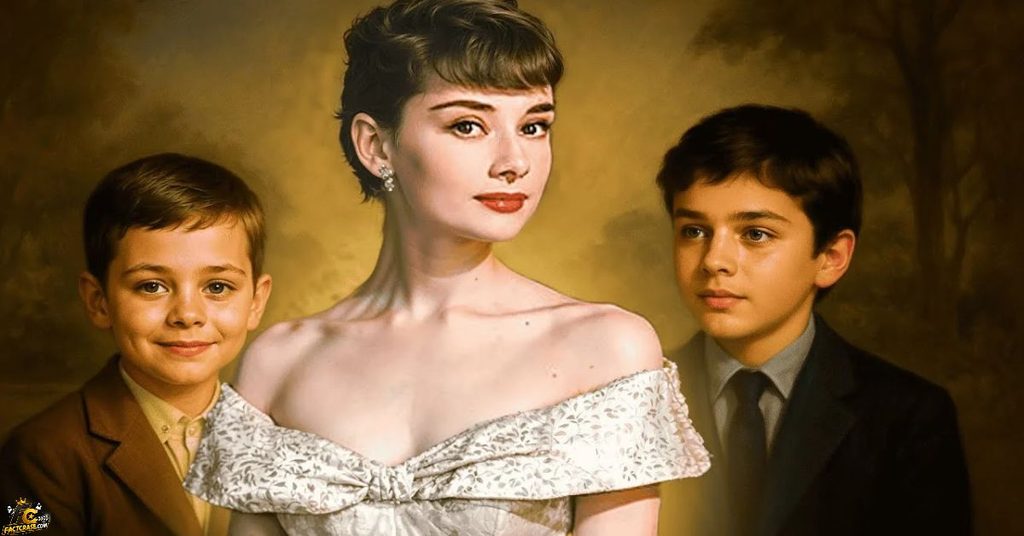
Hepburn’s personal life included three significant long-term relationships. She married actor Mel Ferrer, with whom she had her first child, Sean Ferrer. She later married Italian psychiatrist Andrea Dotti, and they had a son, Luca Dotti.
In her later years, Hepburn was closely associated with actor Robert Wolders. Although her public image was strongly connected with glamour, her later priorities increasingly centered on family and humanitarian work.
Her transition away from frequent acting appearances was gradual. Rather than maintaining the pace of her earlier Hollywood career, she increasingly devoted her time to family and international advocacy.
Read More:Karen Lynch and Elizabeth Taylor: Fact or Myth? 2026
What Did Audrey Hepburn Do for UNICEF?
One of the most important similarities between Audrey Hepburn and Michael Phelps is that both used fame for causes extending beyond their primary professions, although their areas of focus differed.
Hepburn became a UNICEF Goodwill Ambassador in 1988. Her personal experience of wartime hunger gave her a strong connection to UNICEF’s mission. The organization says she traveled extensively to raise awareness of children’s needs and visited projects across Africa, Asia, and Latin America.
Her work included attention to:
- Child nutrition
- Vaccination programs
- Clean water
- Education
- Children’s rights
- Emergency relief
She traveled to countries including Ethiopia, Bangladesh, Turkey, Ecuador, Guatemala, Honduras, Vietnam, Thailand, and Sudan as part of her advocacy. UNICEF records also document her participation in vaccination and child-health initiatives.
In 1992, she received the Presidential Medal of Freedom for her contributions. Despite becoming seriously ill, she continued her UNICEF activities during the final period of her life.
How Did Audrey Hepburn Die?
Hepburn died on January 20, 1993, at her home in Tolochenaz, Switzerland. She was 63.
Her final years were marked by intensive humanitarian work despite serious illness. Her death did not end her association with UNICEF; instead, her humanitarian legacy became an important part of how her life is remembered.
Her career therefore developed through three connected areas: film acting, fashion, and humanitarian work.
Michael Phelps: Early Life and Background
Michael Phelps was raised in Maryland and began swimming at a young age. His mother, Deborah Phelps, supported his development, while his father, Michael Sr., worked as a Maryland state trooper.
Phelps trained under coach Bob Bowman, whose coaching became central to his extraordinary competitive career. His development through the North Baltimore Aquatic Club eventually led him onto the Olympic stage.
How Did Michael Phelps Become the Greatest Olympian Ever?
Phelps made his Olympic debut at the Sydney Olympics in 2000, when he was only 15 years old. He did not win a medal at Sydney, but the experience established him as a serious international prospect.
At the 2004 Athens Games, he won eight medals, including six gold. His performances made him one of the most recognizable swimmers in the world.
The defining moment came at the 2008 Beijing Olympics, where Phelps won eight gold medals, surpassing Mark Spitz’s previous record of seven gold medals at a single Olympic Games.
He continued competing at the highest level at the 2012 London Games and the 2016 Rio Olympics. By the end of his Olympic career, he had accumulated 28 Olympic medals, including 23 gold medals.
That record is why Phelps is widely referred to as the greatest Olympian of all time.
His achievement was not based on a single swimming event. He competed successfully across multiple disciplines, including butterfly, freestyle, individual medley, and relay events. His versatility, training volume, technique, and consistency helped separate him from most competitors.
Michael Phelps’s Family Life
Phelps married Nicole Johnson, a former Miss California USA, and the couple has four sons: Boomer, Beckett, Maverick, and Nico.
Family life became increasingly important after his competitive swimming career. The family has also been associated with Paradise Valley, Arizona, where Phelps has maintained a home and where he has been connected with Arizona State University through his coaching and swimming activities.
His post-Olympic life has included family responsibilities, business partnerships, foundation work, and public advocacy.
Why Is Michael Phelps a Mental Health Advocate?
Another major point of interest surrounding Audrey Hepburn and Michael Phelps is the way both became associated with causes larger than entertainment or sport.
Phelps has spoken publicly about depression, anxiety, and the mental-health challenges he experienced during and after his swimming career. Olympic research and reporting have documented his discussions of post-Olympic depression, particularly following major competitions.
His advocacy emphasizes the importance of seeking help rather than treating mental health struggles as something athletes should simply hide.
Through the Michael Phelps Foundation, he has also promoted swimming and water safety. He has participated in mental-health awareness initiatives and has worked with organizations including Talkspace.
This part of his public life is significant because it changes the traditional image of elite athletes. Instead of focusing only on medals, Phelps has increasingly discussed emotional well-being and the pressures that can accompany extraordinary achievement.
How Much Is Michael Phelps Worth?
There is no universally verified public figure for Phelps’s current wealth. Estimates vary depending on how analysts calculate sponsorship income, investments, property, business interests, and other assets.
Some online estimates place his Estimated Net Worth around $80 million to $120 million, while older estimates have been considerably lower. Therefore, figures such as $20 million should not be presented as a confirmed current valuation.
A substantial part of Phelps’s commercial success has come from endorsement deals. His sponsors and commercial relationships have included Speedo, Under Armour, Omega, and Visa, among others. Forbes previously reported substantial annual sponsorship earnings and noted his long-standing relationships with major brands.
The important point is that his wealth developed after years of international athletic success and commercial partnerships rather than from Olympic prize money alone.
Audrey Hepburn and Michael Phelps: What Do They Actually Have in Common?
At first glance, Audrey Hepburn and Michael Phelps come from completely different worlds. Hepburn became internationally known through classic cinema and fashion, while Phelps built his reputation through Olympic swimming.
Their connection is mainly based on the broader influence they developed after achieving success in their original professions. Both became internationally recognized public figures whose work extended beyond entertainment or sport.
Hepburn served as a UNICEF Goodwill Ambassador from 1988 until her death in 1993, traveling internationally to raise awareness of children’s needs and humanitarian issues.
Phelps later used his public platform to support water safety and mental wellness. His foundation currently focuses on water safety, mental wellness, healthy living and confidence-building programs for young people.
| Shared Theme | Audrey Hepburn | Michael Phelps |
| Primary field | Cinema and acting | Olympic swimming |
| Global recognition | Classic films and fashion | Olympic records |
| Public identity | Actress and style icon | Elite swimmer |
| Humanitarian or advocacy work | UNICEF and children’s causes | Water safety and mental wellness |
| Major legacy | Film, fashion and humanitarian service | Olympic achievement and youth-focused advocacy |
There is no widely documented public record establishing that Hepburn and Phelps personally met. Their connection is therefore best understood as a comparison between two internationally recognized figures from different generations whose public influence extended beyond their original careers.
Frequently Asked Questions
Did Audrey Hepburn and Michael Phelps ever meet?
There is no well-documented public record establishing that Audrey Hepburn and Michael Phelps ever met. Their connection is mainly a modern comparison of two iconic public figures.
What was Audrey Hepburn’s most famous movie?
Breakfast at Tiffany’s remains one of Hepburn’s most recognizable films, while Roman Holiday earned her the Academy Award for Best Actress in 1953.
How many Olympic medals does Michael Phelps have?
Michael Phelps won 28 Olympic medals, including 23 gold medals, three silver medals, and two bronze medals during his Olympic career.
Is Michael Phelps still competing?
No. Phelps is a retired competitive swimmer. His final Olympic appearance came at the 2016 Rio Olympics, after which he continued with family, business, foundation, and advocacy work.
What causes did Audrey Hepburn support?
Hepburn strongly supported children’s rights, nutrition, vaccination, education, emergency relief, and humanitarian programs through her work with UNICEF.
Does Michael Phelps have children?
Yes. Michael Phelps and Nicole Johnson have four sons: Boomer, Beckett, Maverick, and Nico.
Final Takeaway
The stories of Audrey Hepburn and Michael Phelps show how exceptional careers can create influence far beyond a person’s original profession. Hepburn’s transformation from celebrated actress to committed UNICEF humanitarian added another dimension to her legacy, while Phelps turned unprecedented Olympic success into a platform for mental-health awareness, water safety, and youth-focused initiatives.
Hepburn remains associated with classic cinema, fashion, and children’s advocacy, while Phelps remains synonymous with Olympic swimming and record-breaking achievement. Their careers unfolded in different eras and industries, but both demonstrate how sustained public recognition can evolve into broader cultural and charitable influence.